

St. Augustine historically has been home to a number of prominent individuals, such as military leaders, business magnates, and cultural icons. In the process of normative daily research, we at the Research Library discovered another interesting figure who called St. Augustine home for a time: firearms inventor and photographer Andrew Burgess. Burgess was born on January 16, 1837 in Dresden, New York. The farm he grew up on bordered that of famed Civil War photographer Mathew Brady, whom he later apprenticed under. As a photographer, Burgess documented the American South following the Civil War, later leaving the U.S. and documenting the Franco-Prussian War in 1870-1871. His interest in firearms became apparent during this time, as he received his first patent for modernizing Peabody and Werndl arms in late 1871. In 1874, Burgess actually purchased Mathew Brady’s photography studio, where he produced portraits of individuals such as General Winfield Scott Handcock and Secretary of War Edwin McMaster Stanton for a couple of years.
Burgess’ interest in firearms remained strong, as in 1883, he approached firearms manufacturer Colt with an improved design for a lever-action rifle. Similar to Winchester’s Model 1873, Burgess’ rifle incorporated changes that improved accuracy, durability, and reliability. Colt approved of the design and began production, though only around 6400 units were completed. This was a result of Winchester approaching Colt about competition in the rifle market, and the two entities ultimately coming to the agreement that Colt would stick to manufacturing handguns and Winchester would stick to making rifles.
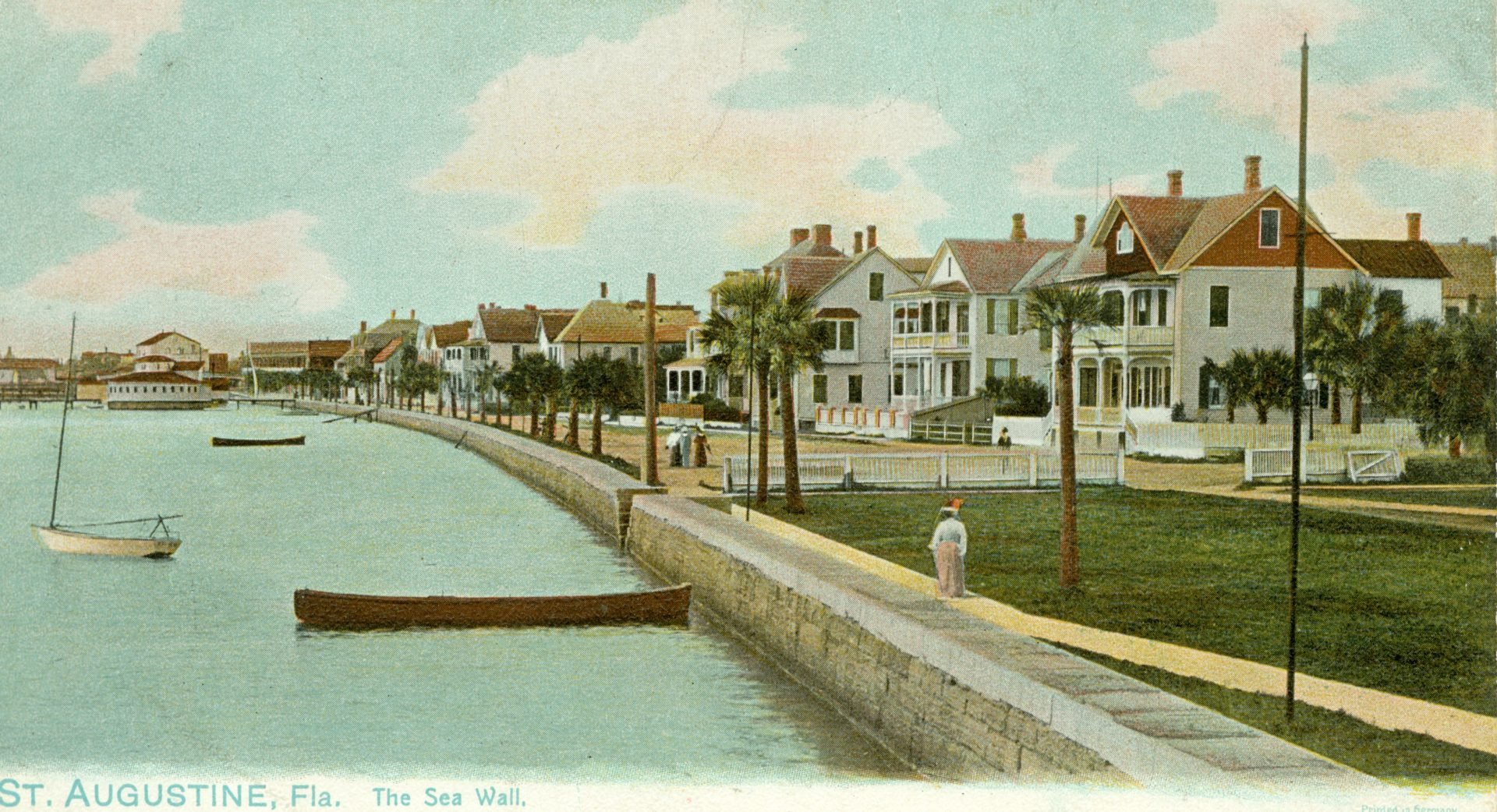
Postcard Image with Burgess House shown with red gables.
This agreement did not stop Burgess, however. He went on to work with Eli Whitney, another notable firearms developer, producing a lever-action rifle that they hoped would be adopted by the U.S. Army during a series of 1878 military trials. The rifle was not adopted, but Burgess continued production for the civilian market. His innovations were later utilized by the Marlin Firearms Company in their Model 1881 lever-action rifle. By 1892, Andrew Burgess established the Burgess Gun Company. Winchester purchased it in 1899.
One of Burgess’ more unique firearms designs was the Burgess Folding Gun, which was a compact weapon designed for use by law enforcement, messengers, and bank security. It was capable of being broken down into two sections and quickly reassembled. It operated in a manner close to what would today be considered semi-automatic (one round fired for each pull of the trigger). Both shotgun and rifle models were built and sold.
In 1896, Burgess filed a patent for a gas-operated, piston-driven handgun he called the “automatic gun.” For its time, this weapon was surprisingly advanced, utilizing principles that have remained a mainstay even in modern firearms. Also at this time, Mauser was working on designs that would evolve into the C96 “Broomhandle” pistol (famously modified to be Han Solo’s blaster in the Star Wars saga), while John Moses Browning was working on designs that would culminate in the M1911, the handgun carried by U.S. troops in World War I and World War II.
Burgess’ patents and inventions were so prolific and influential that he held the most firearms patents issued to an American second only to John Moses Browning, developer of recognizable weapons such as the M1911 pistol, the M2 Browning .50 caliber machine gun, and the Auto-5 shotgun.
Later in life, Burgess frequently resided in St. Augustine. He appears in the 1899 St. Augustine City Directory, living at 14 Bay Street (now 14 Avenida Menendez), near the Castillo de San Marcos. The residence he lived in at 14 Avenida Menendez dates back to between 1895 and 1899, a new construction replacing an earlier structure likely burned down by a major fire in 1895. It is likely Burgess is the one who had the house built. He passed away in St. Augustine on December 10, 1908, but was buried in Owego, New York.
Today, the building that was Andrew Burgess’ home sits between the River and Fort restaurant and the Best Western Bayfront, and is home to the Mayita restaurant.
Written by Robert Covert, Special Collections Manager and Editor-in-Chief
Sources:
White, Robert. “Biography: Andrew Burgess.” ForgottenWeapons.com. ForgottenWeapons.com, April 9, 2014. Accessed March 8, 2024. https://www.forgottenweapons.com/biography-andrew-burgess/“Andrew Burgess’ Automatic Pistol.” HistoricalFirearms.info. HistoricalFirearms.info, 2019. Accessed March 8, 2024. https://www.historicalfirearms.info/post/176784071159/andrew-burgess-automatic-pistol-andrew-burgess#:~:text=Andrew%20Burgess%20was%20a%20photographer,own%20manufacturing%20company%20in%201892
“John Browning’s Gas-Operated Pistol” HistoricalFirearms.info. HistoricalFirearms.info, 2014. Accessed March 8, 2024. https://www.historicalfirearms.info/post/147013210147/john-brownings-gas-operated-pistol-on-the-20th
“Andrew Burgess.” Find-a-Grave.com. Find-a-Grave.com, June 1, 2013. Accessed March 8, 2024. https://www.findagrave.com/memorial/111641709/andrew-burgess
Historic St. Augustine Preservation Board. Florida Master Site File Historic Properties Inventory Form- 14 Avenida Menendez. Florida Master Site File Collection, St. Augustine Historical Society Research Library.
1899 St. Augustine City Directory
“Sanborn Fire Insurance Maps- St. Augustine, St. Johns County, Florida, 1899.” University of Florida George A. Smathers Libraries Digital Collection. University of Florida, 2024. Accessed March 8, 2024. https://ufdc.ufl.edu/UF00074227/00006/images