

In the wake of Abolition in the United States, the Women’s Suffrage Movement kicked off with the first women’s rights convention, organized by notorious suffragists Elizabeth Cady Stanton and Lucretia Mott in 1848 in Seneca Falls, New York. By the turn of the twentieth century, a number of organizations were championing women’s suffrage. Key groups include The National American Woman Suffrage Association (NAWSA), which split in 1869 into The National Woman Suffrage Association (NWSA) and American Woman Suffrage Association (AWSA). Support for the Fifteenth Amendment, which allowed Black men to vote, but not women, was what caused this fracturing. NAWSA would reorganize in 1920 and become the League of Women Voters. Other important organizations included the National Association of Colored Women (NACW), founded in 1896 by Harriet Tubman, Ida B. Wells (also the founder of the Alpha Club in Chicago), Frances Ellen Watkins Harper, and Mary Church Terrell, the organization’s first president. Black women were typically discriminated against by White women’s organizations, and thus created their own to fight for enfranchisement for all and to outlaw lynching.
The 1910s marked a crucial change in suffragist tactics, leading many organizations, including the ones mentioned, to conduct large marches and processions to further champion their cause. One of the most significant marches was held in Washington D.C. on March 3, 1913. Over 5,000 suffragists marched from U.S. Capitol to the Treasury Building, though they were racially segregated. More aggressive tactics led to even more organizations being created. Frustrated with the NAWSA’s leadership, Alice Paul left the organization to form the National Woman’s Party (NWP). The NWP utilized aggressive strategies to capture the vote for women, and even organized the first White House picket in U.S. history on January 10, 1917. Infamously named the “Silent Sentinels,” this group of women protested silently at the gates of the White House six days a week for three years, with signs comparing President Woodrow Wilson to Kaiser Wilhelm II of Germany. Many of these Sentinels were incarcerated for their actions, and held in appalling conditions. Some went on hunger strikes, but were tortuously force-fed by prison staff. Such horrendous actions towards these women garnered support and sympathy for the national Suffrage Movement, eventually leading President Wilson to formally support the movement with an amendment proposal in 1918.
While it appeared that political tides were changing in favor of women’s enfranchisement, there remained strong opposition. It was not until 1919 that the Nineteenth Amendment passed through both the House of Representatives and the Senate. The first states to ratify the amendment were Illinois, Wisconsin, and Michigan. Tennessee was the last state to ratify the amendment on August 18, 1920. After a long and hard-fought victory, women across the country lined up to register for voting, though there were exceptions. Various racial barriers on voting still existed and were enforced across the country with the continuation of Jim Crow. These included such things as poll taxes, literacy tests, and any number of other frivolous means designed to limit the eligible electorate, up to and including violence. None of this entirely stopped Black women and other women of color from fighting and attempting to vote, however. It would take until the 1960s for legislation to be passed (the Twenty-fourth Amendment and the Voting Rights Act of 1965) to reform such practices.
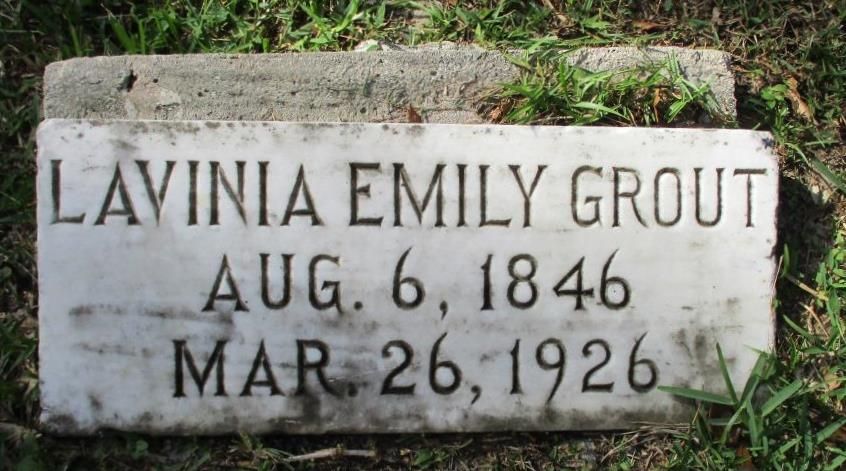
In St. Augustine, the first woman to register to vote was Lavinia Emily (Emma) Grout. Grout was born in Acworth, New Hampshire in 1846, and moved to St. Augustine in 1900. Here, she lived as a nurse/housekeeper, and at one point even occupied the Oldest House grounds from 1914 to 1919. In 1920, Emma Grout was living at 3 Palm Row, and according to a St. Augustine Evening Record article dated September 8, 1920, she was the first woman of Saint Johns County to register to vote, at the age of 74. Emma Grout and many women across the country thus registered and voted for the first time in the 1920 Presidential Election between Warren G. Harding and Calvin Coolidge, all thanks to the efforts of suffragettes that culminated in the Nineteenth Amendment. Grout lived out the rest of her days in St. Augustine, passing away in 1926. She is buried in Evergreen Cemetery. Though she is gone, her name remains permanently affixed to the story of St. Augustine and St. Johns County women.
Written by Shelby Fox, Research Library Assistant
Sources:
“State-by-State Race to Ratification of the 19th Amendment.” National Parks Service. Accessed July 16, 2024. https://www.nps.gov/subjects/womenshistory/womens-suffrage-timeline.htm.
“Why the Women’s Rights Movement Split over the 15th Amendment (U.S. National Park Service).” National Parks Service. Accessed July 16, 2024. https://www.nps.gov/articles/000/why-the-women-s-rights-movement-split-over-the-15th-amendment.htm.
“Woman Suffrage and the 19th Amendment.” National Archives and Records Administration. Accessed July 16, 2024. https://www.archives.gov/education/lessons/woman-suffrage#background.
St. Augustine Historical Society Vertical File on “Emma” Grout.