

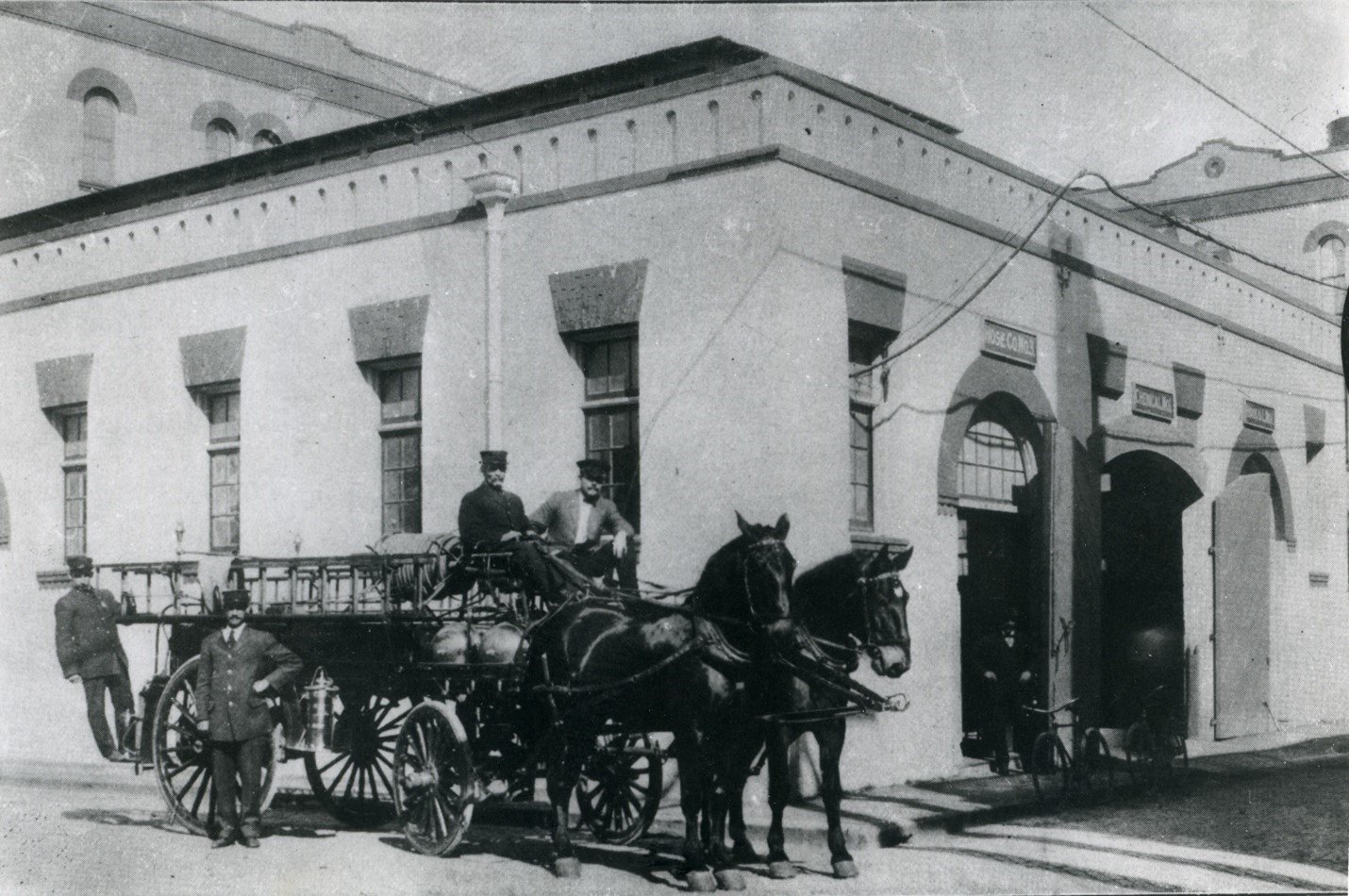
Image: Fire Station and City Hall Building ca. early 20th century
As the Civil War came to an end and Reconstruction was underway, many former slaves in the south were beginning to take full advantage of their newfound freedom, specifically with voting and running for public office. Roughly three years after the war ended, the Republican Party began infiltrating the state of Florida around June and July of 1868 on the premise of Black Suffrage. According to some historians, while the Democratic Party favored the South, St. Augustine’s Republican Party was quite influential. Partly, due to the fact that is believed that the population of St. Augustine was at least half Black. Thus, the Republican Party of the state of Florida was divided into four factions: White Loyalists, carpetbaggers, the state’s principle Black churches, and the Black electorate generally. However, Whites ruled the Ancient City until the 1870s, but afterward approximately sixteen to two-dozen Black men held a variety of public offices for roughly three decades. One of whom was John Papino, one of St. Augustine’s first Black City Councilman. John Papino was a Councilman from Lincolnville ward, the mostly black city precinct and one of four voting wards created at that time.
Papino not only was one of St. Augustine’s earliest African American City Councilman, but also made headlines for being shot in the face at a council meeting on October 30, 1902. The perpetrator was the City Marshal, Charles Benet. According to the St. Augustine Record’s report on the event the next day, Marshal Benet requested that the city council set aside thirteen dollars for the purchase of four new uniforms. As the record put it, ““colored” Alderman (Councilman) John Papino objected to the expenditure.” Tensions escalated when Papino objected the motion a second time and Marshal Benet told Papino, an elected official to, “shut up.” As a response Papino reminded Benet of his office and that with a position such as Marshal in which Papino had held previously, he had no right to silence a councilman. Benet then drew his revolver and shot Councilman Papino with a .38-caliber cartridge in the face. The bullet entered through his right cheek and remained stuck there.
It was chaos, and thus many councilmen and attendees fled the scene of the crime while some stayed to care for Papino and his wound. While, there were several witnesses to the attack and the identity of the suspect was indisputable, Marshal Benet was not initially taken into custody nor was he suspended or removed from his position as Marshal. Instead, Benet turned himself over to the sheriff. After a week had passed, the City Counsel decided to file charges against Benet and suspension from his post came along with it. However, Benet was never put on trial for his unlawful actions that occurred on October 30, 1902. Councilman Papino survived the attack but was the last Black city resident to serve on the City Council until Henry Twine in 1983.
Written by Shelby Fox, Research Library Assistant
Works Cited:
Brown, Canter. Florida’s Black Public Officials: 1867-1924. Tuscaloosa, Alabama: University of Alabama Press, 1998.
Columnist, Susan R. Parker. “Oldest City: Councilman Shot over City Police Uniform Purchase.” St. Augustine Record, November 16, 2019. https://www.staugustine.com/story/news/local/2019/11/16/oldest-city-councilman-shot-over-city-police-uniform-purchase/2276724007/.
Graham, Thomas. “St. Augustine Enters the Modern Era.” Essay. In Oldest City: The History of St. Augustine, 2019 ed., 199–221. St. Augustine, Florida: St. Augustine Historical Society, 2019.
U.S. Census Bureau